


The Book of Obadiah is a prophetic oracle of divine judgment against Edom, the nation descended from Esau and a longstanding enemy of Israel. The prophecy condemns Edom for its pride, arrogance, and, most centrally, for its violent betrayal and exploitation of Judah during the Babylonian conquest and destruction of Jerusalem around 587 BCE. The book promises that Edom will be utterly destroyed for its crimes, while a remnant of Israel will be restored and possess its land, culminating in the establishment of God's kingdom. The core message is that God defends His covenant people and will sovereignly bring justice against all who oppose them, making Obadiah a stark warning against pride and a reassurance of God's ultimate justice.




Important Note: Obadiah is only 21 verses long. This plan will move through it slowly, allowing time to reflect on its core themes, connect them to other parts of the Bible, and apply them personally.
-
Devotional Thought: The book opens with a powerful statement: "The vision of Obadiah. Thus says the Lord God..." This reminds us that the message comes from a divine vision, not human opinion. The God who sees all (Edom's pride and Judah's pain) is the same God who speaks. Before we hear the difficult words of judgment, we are anchored in the truth that God is present, paying attention, and communicating. He is not silent in the face of injustice.
Spiritual Practice:Listening Prayer. Begin your quiet time in silence, asking God to help you hear His voice through His word today, not just your own thoughts or pre-conceptions.
Conversation Starter with Your Kiddos: "If you had a superpower to see something happening far away that was wrong, what would you do? Today we're reading a book from a prophet who God gave a special message to about something wrong happening far away."
-
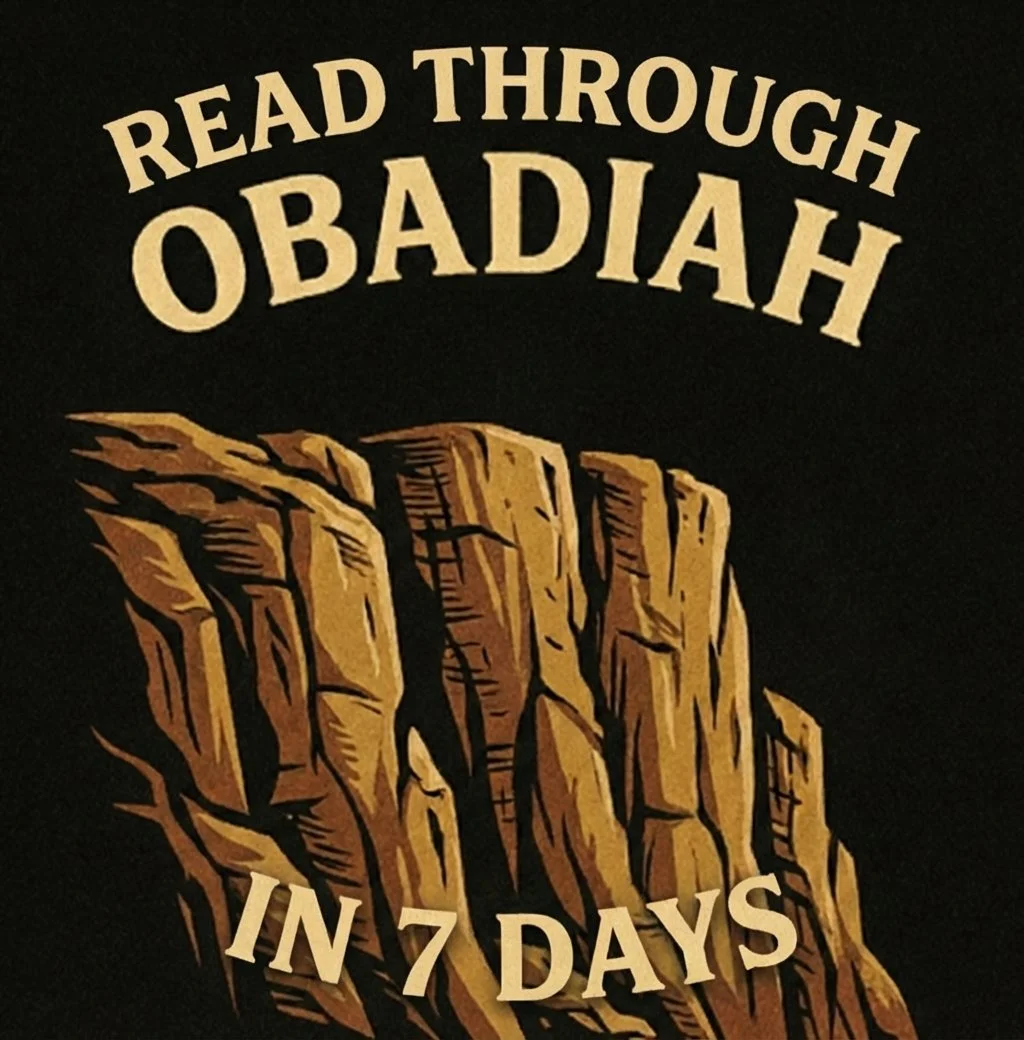
Devotional Thought: God's judgment targets Edom's foundational sin: pride. Their security in the "clefts of the rock" (likely their capital, Petra, carved into cliffs) led them to boast, "Who will bring me down to the ground?" They believed their geographical and political position made them untouchable. God's response is definitive: even if you soar like an eagle, He will bring you down. Pride, the belief in our own self-sufficiency above God, is the root of our downfall.
Spiritual Practice: Examination. Reflect: "In what area of my life (career, intellect, relationships, spirituality) am I tempted to say, 'I've got this,' without relying on God?" Confess this pride.
Conversation Starter with Your Kiddos: "What does it mean to be 'proud'? (Not the good kind, like being proud of your family, but the kind that says 'I'm better than everyone.') Can you think of a time when being too proud got someone in trouble in a story?"
-
Devotional Thought: The prophecy details the completeness of Edom's coming ruin. Thieves and grape-gatherers leave something behind, but Edom will be stripped utterly bare. Their trusted allies and wise counselors will turn against them. This reflects a spiritual principle: when we align ourselves against God's purposes, the very things we trust in—wealth, friends, intelligence—will fail us. Edom had the opportunity to be a brother to Israel but chose enmity, leading to total loss.
Spiritual Practice: Intercession. Pray for nations and leaders today who exploit the vulnerable. Pray they would turn from greed and pride to justice and wisdom.
Conversation Starter with Your Kiddos: "If you saw your brother or sister getting picked on, what should you do? In our story, Edom was like a brother to Judah, but when Judah was in trouble, Edom made it worse. How does that make you feel?"
-
Devotional Thought: This is the heart of the indictment. God lists Edom's specific crimes: standing aloof, gloating, looting, and even handing over survivors on the day of Judah's disaster. Their sin wasn't just hatred; it was betrayal of kinship and a failure of basic human compassion. They saw their "brother" in distress and chose to profit from it. It challenges us: Do we remain passive or, worse, take advantage when others suffer, especially those we are connected to?
Spiritual Practice: Active Compassion. Identify one person or group in a difficult situation. Move beyond passive pity. Act today: send an encouraging note, give a small gift, or offer practical help.
Conversation Starter with Your Kiddos: "Remember when we talked about what to do if your sibling is getting picked on? What are some wrong choices you could make instead? (Like laughing, joining in, or taking their toy while they're sad.) That's what Edom did."
-
Devotional Thought: The perspective shifts from Edom to a universal principle: "As you have done, it shall be done to you." This is the "lex talionis" (law of retaliation) applied on a national scale. The "cup" of God's wrath that the nations drink symbolizes the inevitable consequences of evil actions. While the imagery is fierce, it underscores a bedrock truth: God's moral universe is structured so that cruelty and injustice ultimately recoil on the perpetrators. Justice is not abandoned to chance; it is in God's hands.
Spiritual Practice: Releasing Vengeance. Is there someone you wish would "get what they deserve"? Entrust that person and your hurt to God, the just judge, in prayer. Let go of the desire to repay evil for evil.
Conversation Starter with Your Kiddos: "You know how if you throw a boomerang, it comes back to you? God says the mean things Edom did will come back to them. Why is it important that God is fair and just, even when it's hard?"
-
Devotional Thought: After the fire of judgment, we see the light of hope. For God's people, there will be deliverance (MountZion), holiness, and possession of what was promised. The "house of Jacob" and "house of Joseph" will be a fire consuming the stubble of Edom. This is not about human vengeance but divine restoration. God will re-establish His people, and they will fulfill their role. His promises are not annulled by disaster. Our hope is not in our own strength but in God's faithful commitment to restore and dwell with His people.
Spiritual Practice: Hope-Filled Remembrance. Write down a past disappointment or loss. Next to it, write: "But God is a God of restoration." Meditate on His ability to redeem and restore in His time and way.
Conversation Starter with Your Kiddos: "Imagine your favorite toy got broken. Now imagine a master builder promises to not only fix it but make it even better. That's what God promises His people in the end—He will fix what's broken and make things right."
-
Devotional Thought: The book concludes with its ultimate goal: "Saviors shall go up to Mount Zion to rule Mount Esau, and the kingdom shall be the Lord's." Human kingdoms marked by pride and violence (Edom) will give way to God's righteous rule administered through "saviors" or deliverers. The final note is one of profound hope: universal sovereignty belongs to YHWH. All history is moving toward the day when every knee will bow, and God's justice and peace will reign unopposed. Our present loyalty belongs to this coming Kingdom.
Spiritual Practice: Kingdom Prayer. Pray the Lord's Prayer (Matthew6:9−13), focusing intently on the final lines: "Your kingdom come, your will be done, on earth as it is in heaven... For yours is the kingdom, and the power, and the glory, forever."
Conversation Starter with Your Kiddos: "What do you think a perfect kingdom ruled by God would be like? (No crying, no sickness, everyone being kind.) The very last sentence of our book says that one day, God will be the King of everyone and everything. Let's draw a picture of what that happy kingdom might look like!"
-
1. Deepen Your Biblical Understanding
Trace the "Edom" Theme: Obadiah is one voice in a chorus of biblical texts about Edom. Read the other major prophetic judgments against them to see the full picture: Isaiah34, Jeremiah49:7−22, Ezekiel25:12−14, and Malachi1:2−5. How does each prophet emphasize a different aspect of their sin and God's character?
Explore the "Brother" Dynamic: Go back to the source of the conflict. Read the story of the twin brothers Jacob and Esau (Genesis25−27, 33). Then, read God's command to Israel in Deuteronomy23:7−8 regarding Edom. How does this backstory make Edom's betrayal in Obadiah even more tragic?
Connect to the New Testament: The theme of "pride before a fall" is universal. Read Luke14:11 and James4:6. The final verse of Obadiah—"the kingdom shall be the Lord's"—finds its ultimate fulfillment in Christ. Read Revelation11:15 and 19:6. How does Obadiah's hope point forward to Jesus and the New Creation?
2. Apply the Themes Personally & Communally
Pride Audit: Based on Day 2's reflection, choose one specific area where you identified pride (self-reliance, looking down on others, etc.). For one week, implement a "humility practice." This could be:
Asking for help in that area.
Intentionally listening to someone you usually dismiss.
Writing down three things you're grateful for that you did not earn.
Active Compassion Project: Take the "Active Compassion" practice from Day 4 and make it a family or small group project. Identify a local need (a food bank, a refugee ministry, a lonely neighbor) and commit to serving together once a month for the next three months.
Study Justice & Mercy: Obadiah is a stark book of divine justice. Wrestle with how this fits with God's mercy. Read a parallel book like Jonah, where God's mercy to a violent enemy (Nineveh) is central. Discuss: How do God's justice and mercy coexist? What does this mean for how we view global injustice today?
3. Expand Your Devotional Practice
Try a Different Translation: Re-read Obadiah in a different Bible translation (e.g., if you used the ESV, try the NLT or The Message for fresh phrasing). Notice what new insights or emphases stand out.
Prayer-Walk the Text: Use the structure of your 7-day plan as a prayer guide for a week of intercession.
Day 1: Pray for those receiving hard messages from God (pastors, leaders, prophets).
Day 2: Pray against the spirit of pride in your nation and leaders.
Day 3: Pray for nations whose trust in allies or wealth is failing.
Day 4: Pray for victims of betrayal, especially within families and churches.
Day 5: Pray for God's justice to roll down in situations of oppression you know of.
Day 6: Pray for the restoration of broken people and communities.
Day 7: Worship, declaring "The kingdom is the Lord's!"
Memorize Key Verses: Commit to memory the thematic anchors: the warning against pride (Obadiah3−4), the law of consequences (Obadiah15), and the hope of the kingdom (Obadiah21).
4. Engage with Your Community
Host a Mini-Bible Study: Use your 7-day plan as an outline to lead a 1-2 hour discussion group on Obadiah. Share your insights and listen to others'.
Collaborate on the "Kiddos" Ideas: If you used the conversation starters with your children, ask them which one they liked best. Encourage them to teach the story or draw a picture to explain it to a grandparent or friend, reinforcing their learning.
Bridge to Current Events: With discernment, discuss how the themes of Obadiah might speak to modern geopolitical conflicts, social betrayals within communities, or the dangers of national arrogance. The goal is not to make simplistic parallels but to see how biblical principles remain urgently relevant.
Suggested Follow-Up Reading
To continue in the Minor Prophets, consider moving to:
Jonah: For a contrasting picture of God's heart for violent Gentile nations.
Amos: For a powerful expansion on the themes of social justice and hypocrisy among God's own people.
Micah: For a beautiful blend of judgment and hope, culminating in the famous call to "do justice, love mercy, and walk humbly with your God" (Micah6:8).
